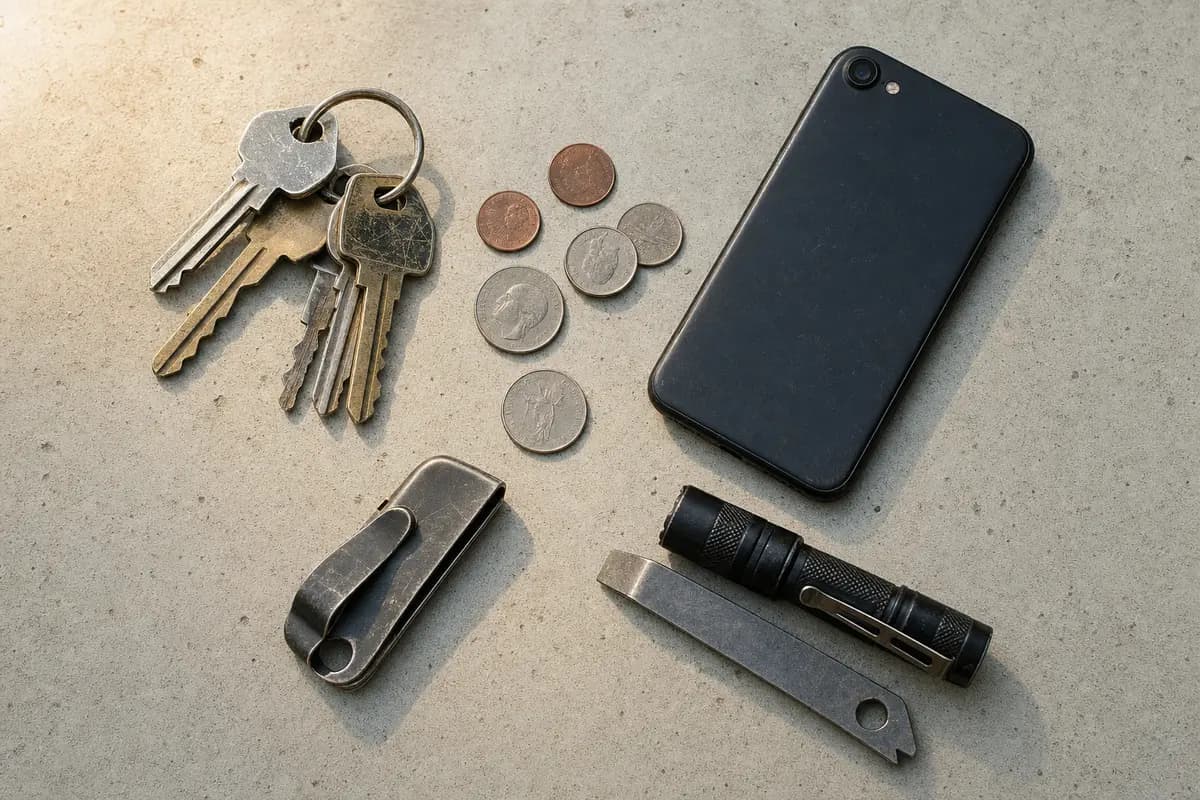
5 Things Rattling in Your Pockets (And How to Shut Them Up)
You stand up from your desk and your pocket sounds like a tambourine. You walk into a quiet room and everyone hears you coming. It's not just annoying — it means your gear is getting scratched, your phone screen is taking micro-damage, and you're broadcasting your carry to everyone around you.
Silent carry isn't just about comfort. It's about protecting your gear, maintaining awareness of your items, and keeping your EDC discreet.
Here's what's actually causing the noise — and the fixes that work long-term, not just for a day.
1. Loose Keys (The #1 Offender)
A bare keyring is a wrecking ball inside your pocket. Metal keys grinding against each other, against your phone, against your tools. They're the single most damaging item in any pocket.
Why it's worse than you think: Keys don't just make noise — they scratch phone screens through cases, wear down tool finishes, and the irregular shapes create pressure points when you sit.
Real fixes:
- Key organizer (OrbitKey, KeyBar, KeySmart): Stacks keys flat like a Swiss Army knife. Eliminates all metal-on-metal contact. The OrbitKey Active handles 2-7 keys in silicone; the Orbitkey Leather does the same in matte leather for a dressier look.
- Leather key slip: A simple folded leather pouch that wraps your keys. Cheaper than organizers, equally quiet. Tons of options on Etsy from $15-30.
- Suspension clip: Moves keys from pocket interior to belt loop. They hang inside but don't share space with anything else. A titanium carabiner works well for this.
2. Metal-on-Metal Contact
Two hard items in the same pocket will always find each other. Flashlight against a pry bar. Multitool against a lighter. The sound is a dull tink-tink-tink with every step.
Why it's worse than you think: Beyond noise, this causes finish wear. That Olight i3T is getting its anodizing ground off by the steel lighter next to it. Check your gear — you'll see the contact marks.
Real fixes:
- The one-hard-item-per-pocket rule: The simplest and most effective fix. If it's metal, it gets its own pocket or it gets a sheath.
- Pocket pouch/organizer: A slim leather or nylon slip that holds 2-3 items separated. Keeps everything accessible but isolated. Brands like Viperade, Maxpedition, and countless Etsy makers offer them from $12-40.
- Paracord or rubber band wrap: For items that ride together on a carabiner — wrap a length of paracord or a wide rubber band around the contact point. Also works on magnesium fire starters (wrap the striker to the rod with a small piece of tape).
- Kydex sheaths: For fixed items like pry bars, a thin Kydex pocket sheath adds zero bulk but eliminates all contact noise.
3. A Bad Pocket Clip
Your pocket clip should hold your tool absolutely still. If it's bouncing, swaying, or letting the tool pivot with each step, you've got a noise source — and a deployment problem.
Signs your clip is failing: The tool tilts away from your pocket wall when you walk. You can feel it shifting when you sit down. There's a rhythmic tap against your thigh.
Real fixes:
- Bend it tighter: Most clips are spring steel. You can carefully bend the clip inward to increase tension. Use pliers with cloth to avoid scratching.
- Deep carry clip swap: Aftermarket deep-carry clips sit the tool lower in your pocket and typically have stronger retention. Lynch Northwest and MXG Gear are popular options. The UltiClip Slim 3.3 is another great universal option that works with almost anything.
- Position check: A clip at your pocket seam (the reinforced edge) grips better than mid-pocket. Move it to the corner if it's sliding around.
4. Coins and Pocket Debris
Loose change, screws you picked up, a paperclip from work — pocket debris accumulates and rattles against everything else. Three pennies can make a quiet pocket sound chaotic.
Real fixes:
- Dedicate the coin pocket: That small fifth pocket on your jeans exists for this. Use it for coins, AirPods, or a single small item — nothing else.
- Go coinless: Drop coins in your car, a jar at home, or just don't accept them. This is 2026 — tap to pay handles 95% of transactions.
- End-of-day dump: Build a habit of emptying pocket debris every evening. A small valet tray by your front door makes this automatic.
5. Your Phone Sharing Space
Your phone is the most expensive and most fragile item in your pockets. It should never share space with anything hard.
Why it's worse than you think: Even through a case, metal items create micro-scratches on the case finish and can apply pressure that damages the display over time. A key pressing against your screen while you sit is applying concentrated force to one small point.
Real fixes:
- Phone-only pocket (non-negotiable): One pocket, one purpose: phone only. This is the single highest-impact change you can make. Most people already do this instinctively — if you don't, start today.
- Screen-inward carry: Face the screen toward your thigh. If something does get in there, it hits the back of the case, not the screen.
- Pocket orientation: Right-handed? Phone in left front pocket (screen faces thigh), carry gear in right front pocket. Keeps your dominant hand free for tool access.
The Pocket Assignment System
The EDC community has largely converged on a standard pocket layout. It works because it's consistent — muscle memory takes over after a week:
| Assignment | Why | |
|---|---|---|
| Front right | Primary tool (knife/multitool) clipped, lighter or pen | Dominant hand access |
| Front left | Phone only | Protected, easy access |
| Coin pocket | Flashlight or AirPods | Snug fit, no movement |
| Back right | Wallet (slim) | Traditional, low-profile |
| Back left | Handkerchief or empty | Backup space |
The key insight: every item has exactly one home. You never search, you never double-stack hard items, and you never create metal-on-metal contact.
When Organization Isn't Enough
If you carry more than 4-5 items daily, pockets alone won't cut it. That's when you graduate to:
- Belt-mounted pouches: Small MOLLE-style pouches that ride on your belt under a shirt. Invisible, accessible, and they take overflow items out of your pockets entirely.
- EDC sling bag: A small crossbody that holds everything beyond your core pocket carry. Keeps your pants comfortable while expanding capacity.
The goal isn't to carry less — it's to carry smarter. Silent pockets mean organized pockets, and organized pockets mean faster access, less gear damage, and zero announcements when you walk into a room.
Silent carry is confident carry. Master it once and you'll never go back.

